2 releases
Uses new Rust 2024
| new 0.2.4 | Jun 9, 2026 |
|---|---|
| 0.2.1 | May 29, 2026 |
#11 in #manifold
2MB
44K
SLoC
rlx-umap
RLX implementation path for parametric UMAP (fast-umap).
Scope
| Layer | Feature | What it covers |
|---|---|---|
| Building blocks | cpu, graph, bench |
Cosine/Euclidean pairwise [n,n], umap.knn, graph helpers, multi-backend parity |
| Full parametric UMAP | full (default) |
Umap::fit, FittedUmap::transform, sparse cross-entropy + Adam, MLP encoder, weight save/load — port of fast-umap training loop on RLX Session |
Benchmarks (bench_knn, bench_batch) still time only the building-block path (pairwise + k-NN), not Umap::fit. Use umap_demo or tests for full fit smoke checks.
Full UMAP quick start
cargo run -p rlx-umap --release --example umap_demo --features full

# CLI training runner (RLX autodiff only — no Burn)
cargo run -p rlx-umap --release --bin train-umap --features full -- \
  --synthetic --n 1000 --epochs 50 --save /tmp/model.ruama

# MNIST → 2-D embedding (downloads data, writes SVG + CSV)
cargo run -p rlx-umap --release --example mnist_embedding --features full
cargo run -p rlx-umap --release --example mnist_embedding --features full -- \
  --n 10000 --epochs 150 --out docs/mnist_embedding.svg --csv docs/mnist_embedding.csv
use rlx_umap::prelude::*;

rlx_umap::register();
let config = UmapConfig::default();
let fitted = Umap::new(config).fit(data);
let mut fitted = Umap::new(config).fit(data);
let out = fitted.transform(new_points); // uses training z-score stats
fit_with_progress reports EpochProgress every few epochs.
Library training entry points (same loop as Umap::fit, RLX grad_with_loss + host Adam):
training::fit/fit_with_progresstraining::train_only— weights + compiled graphs, noFittedUmapwrappertrain-umapbinary — CSV / f64 matrix /--syntheticdata
Save / load
Weights and full models use safetensors (.safetensors, default) or GGUF F32 (.gguf). Legacy .ruama archives still load.
| API | Format (by file extension) |
|---|---|
FittedUmap::save |
.safetensors or .gguf — weights + rlx_umap.* metadata + norm stats + UmapConfig |
FittedUmap::load |
Auto-detect; config embedded in metadata |
FittedUmap::save_weights |
Weights + shapes in metadata |
WeightStore::load |
safetensors / GGUF / .ruama |
use rlx_umap::prelude::*;

fitted.save("/tmp/my_umap.safetensors")?;
fitted.save("/tmp/my_umap.gguf")?;  // F32 GGUF (feature `io-gguf`)
let mut loaded = FittedUmap::load("/tmp/my_umap.safetensors", Device::Cpu)?;
Training: global k-NN on the training device (fused pairwise → umap.knn on CPU/Metal/wgpu/CUDA — CUDA runs k-NN via GPU pairwise + host umap.knn inside Op::Custom; MLX: GPU pairwise + CPU umap.knn; NN-Descent for n ≥ 10_000 with nn-descent) → fixed-size edge batches → RLX grad_with_loss backward → host Adam. wgpu/CUDA rewrite non-last-axis Reduce (e.g. PCA MSE) and unsupported backward ops (via shared LowerBackwardOps). Optional PCA warm-start (pca feature, on by default).
For GPU UMAP fit, enable the matching backend feature and device, e.g. full,metal + Device::Metal, full,mlx + Device::Mlx (macOS), full,gpu + Device::Gpu, or full,cuda + Device::Cuda.
# Full fit benchmark (not pairwise/k-NN only)
cargo run -p rlx-umap --release --example bench_umap --features full -- --n 256 --epochs 50
cargo run -p rlx-umap --release --example bench_umap --features full,metal -- --device metal
cargo run -p rlx-umap --release --example bench_umap --features full,mlx -- --device mlx
cargo run -p rlx-umap --release --example bench_umap --features full,gpu -- --device gpu
cargo run -p rlx-umap --release --example bench_umap --features full,cuda -- --device cuda
Disable extras: cargo build -p rlx-umap --no-default-features --features full,cpu,graph,bench (turns off pca / nn-descent).
Ops
| Name | Inputs | Output | Description |
|---|---|---|---|
umap.knn |
pairwise [n, n] f32 |
packed [n, 2k] f32 |
Per-row k smallest distances (skip self). Columns 0..k = neighbour indices (f32-encoded), k..2k = distances. |
umap.knn_backward |
pairwise [n, n], d_dist [n, k] |
d_pairwise [n, n] |
Scatter distance gradients to selected matrix entries (feature autodiff). |
Graph builders (no custom op): pairwise_cosine_graph, pairwise_euclidean_graph, cosine_knn_graph.
Benchmarks
Cosine distance 1 - cos(θ) plus k-NN. Reference on host: cosine_pairwise_reference + knn_forward_packed.
bench_knn — parity + speed (single n)
cargo run -p rlx-umap --release --example bench_knn
cargo run -p rlx-umap --release --example bench_knn --features metal,mlx,gpu
cargo run -p rlx-umap --release --example bench_knn --features all-backends

# e.g. cargo run -p rlx-umap --release --example bench_knn -- --n 512 --d 64 --k 15 --runs 10
| Section | Metrics |
|---|---|
| Parity | Pairwise max abs err vs reference; k-NN index match rate, mean dist err, distance histogram L1 |
| Speed | Median pairwise / knn / e2e ms per backend |
Parity (typical, n=128, d=32, k=8, macOS):
| backend | pairwise max err | index match |
|---|---|---|
| cpu | ~2×10⁻⁷ | 1.0000 |
| metal | ~3×10⁻⁷ | 1.0000 |
| mlx | ~2×10⁻⁷ | 1.0000 |
| wgpu | ~3×10⁻⁷ | 1.0000 |
Integration tests: tests/cosine_parity.rs, tests/backend_parity.rs (enable metal, mlx, gpu features).
bench_batch — timing vs batch size (n = number of points)
Sweeps batch size n (not a separate batch dim). Compiles once per (backend, n), then times runs only.
cargo run -p rlx-umap --release --example bench_batch --features metal,mlx,gpu

# Default sizes: powers of 2 from 1 to 4096 → 1, 2, 4, …, 4096
cargo run -p rlx-umap --release --example bench_batch --features metal,mlx,gpu \
  -- --runs 5 --warmup 1

# Every n from 1 to 4096 (slow) + CSV for plotting
cargo run -p rlx-umap --release --example bench_batch --features metal,mlx,gpu \
  -- --batch-min 1 --batch-max 4096 --batch-step 1 --csv /tmp/umap_batch.csv

# Custom sizes
cargo run -p rlx-umap --release --example bench_batch -- \
  --batch-sizes 64,128,256,512,1024 --d 64 --k 15
| Flag | Default | Meaning |
|---|---|---|
--batch-min / --batch-max |
1 / 4096 |
Range (with power-of-2 steps if --batch-step unset) |
--batch-step |
(off) | Linear step, e.g. 1 → every integer in range |
--batch-sizes |
— | Comma list overrides range |
--d |
64 |
Embedding dimension |
--k |
15 |
Neighbours (min(k, n-1) when n ≥ 2) |
--warmup / --runs |
1 / 5 |
Timing repeats |
--csv |
— | Write n,k,d,backend,pairwise_ms,knn_ms,e2e_ms,status |
n=1 skips k-NN (k < n). Output: markdown tables (e2e + pairwise ms) and optional CSV.
Results chart (May 2026) — building blocks only
Not full UMAP — cosine pairwise matrix + k-NN per row (same subgraph fast-umap uses for global k-NN, not the neural fit() loop).
Timing vs n (powers of 2, d=64, k=15, release, warmup=1, runs=5). macOS (Apple Silicon), Windows + WSL Ubuntu on RTX 4090 via rig.sh.
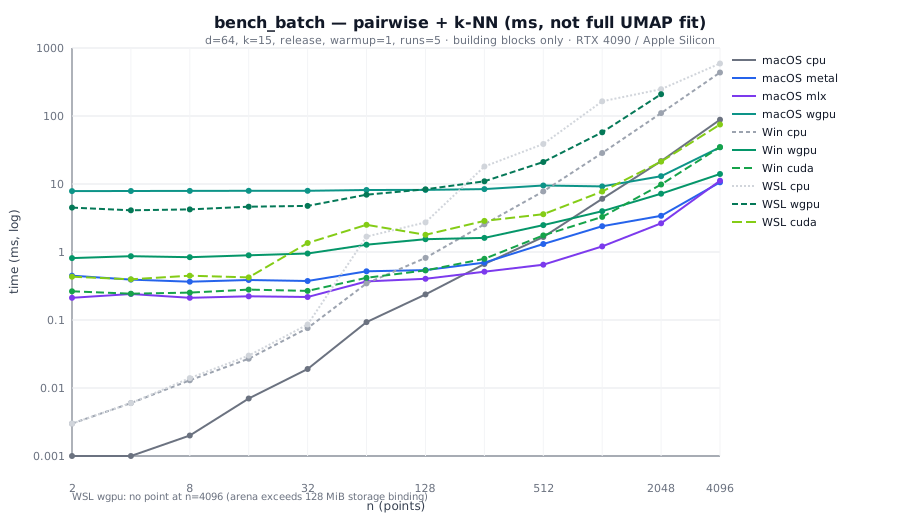
Raw rows: docs/bench_batch_e2e.csv.
E2E time (ms) — selected n:
| n | macOS metal | macOS mlx | macOS wgpu | Win wgpu | Win cuda | WSL cuda |
|---|---|---|---|---|---|---|
| 128 | 0.54 | 0.40 | 8.2 | 1.55 | 0.54 | 1.79 |
| 512 | 1.31 | 0.65 | 9.5 | 2.49 | 1.75 | 3.60 |
| 1024 | 2.40 | 1.21 | 9.2 | 3.99 | 3.28 | 7.75 |
| 2048 | 3.41 | 2.64 | 13.0 | 7.20 | 9.82 | 21.3 |
| 4096 | 10.6 | 11.2 | 34.7 | 14.0 | 34.8 | 75.0 |
| n | macOS cpu | Win cpu | WSL cpu | WSL wgpu |
|---|---|---|---|---|
| 128 | 0.24 | 0.82 | 2.72 | 8.34 |
| 2048 | 21.7 | 110 | 248 | 209 |
| 4096 | 88.4 | 437 | 592 | panic* |
*WSL wgpu at n=4096: arena exceeds Vulkan max_storage_buffer_binding_size (128 MiB); use CUDA or cap --batch-max 2048.
Reproduce:
# macOS
cargo run -p rlx-umap --release --example bench_batch --features metal,mlx,gpu,graph,bench \
  -- --batch-min 1 --batch-max 4096 --csv docs/bench_batch_e2e_macos.csv

# CUDA rig (sync workspace first)
../rig.sh sync
../rig.sh cargo run -p rlx-umap --release --example bench_batch --features cuda,gpu,graph,bench \
  -- --batch-min 1 --batch-max 4096 --csv D:/rlx-workspace/bench_batch_windows.csv
../rig.sh --wsl cargo run -p rlx-umap --release --example bench_batch --features cuda,gpu,graph,bench \
  -- --batch-min 1 --batch-max 4096 --csv /mnt/d/rlx-workspace/bench_batch_wsl.csv
bench_batch does not re-check parity each n; use bench_knn or the tests above for correctness.
Backend notes
- Pairwise cosine uses matmul tiling (
[n,n]only) so Metal/wgpu match CPU (avoids broken[n,1]+[1,n]broadcast adds on those backends). Constants are O(n) vectors (outer-product matmul), not densen×nuploads. umap.knn: CPU + Metal host k-NN; wgpu uses GPU kernel whenn ≥ 256, else partial host I/O; CUDA / ROCm host k-NN with partial arena memcpy.- MLX fit k-NN:
encoder::knn::knn_mlx_hybrid— MLX pairwise + CPUumap.knn(same assession::cosine_knn_mlxfor cosine). MLP training uses native MLX backward ops.
Usage (building blocks)
rlx_umap::register();

use rlx_ir::{DType, Graph, Shape};
use rlx_umap::{knn_graph, split_knn_packed};

let mut g = Graph::new("knn");
let pairwise = g.input("pairwise", Shape::new(&[100, 100], DType::F32));
let packed = knn_graph(&mut g, pairwise, 15);
let (indices, distances) = split_knn_packed(&mut g, packed, 15);
g.set_outputs(vec![indices, distances]);
With full, see Full UMAP quick start above. CPU custom ops register via register; training graphs compile through rlx-runtime Session.
License
GPL-3.0-only (RLX workspace).
Dependencies
~2–28MB
~477K SLoC