2 unstable releases
Uses new Rust 2024
| 0.27.0 | May 10, 2026 |
|---|---|
| 0.26.0 | Mar 8, 2026 |
#1 in #full-text-search
Used in 6 crates
13KB
290 lines
lucivy v2






BM25 full-text search engine with substring matching, fuzzy search, and regex — all cross-token aware.
Built for code search, technical documentation, and as a BM25 complement to vector databases.
What's new in v2
- SFX-only engine — all queries route through the Suffix FST, no legacy code paths
- 5 bindings — Python, Node.js, C++, WASM (emscripten), Rust
- Distributed search —
export_stats/merge_stats/search_with_global_stats - Incremental sync — LUCIDS sharded delta export/apply
- Correct BM25 cross-shard — identical scores whether 1 shard or 4 (diff=0.0000)
- 0 clippy warnings — clean CI with
-D warnings
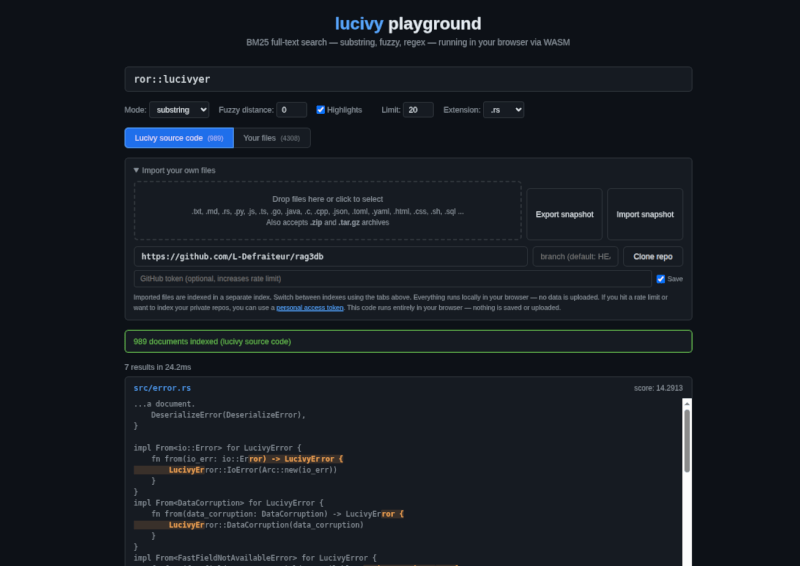
Try the live playground — runs entirely in your browser via WASM.
What makes lucivy different
Most search engines match whole tokens. Search for "mutex" and you'll find the word "mutex" — but not "getMutexHandle" or "lockmutex", because the tokenizer sees those as single opaque tokens. lucivy matches substrings inside tokens: "mutex" finds every occurrence, even buried inside compound words, camelCase identifiers, or concatenated strings.
This works because lucivy builds a Suffix FST (.sfx) at indexing time. Every suffix of every token is indexed, partitioned by position (SI=0 = token start, SI>0 = substring). This makes substring search as precise as exact-match search, with BM25 scoring.
Cross-token matching
Tokenizers split text at word boundaries. "rag3weaver" becomes ["rag3", "weaver"]. Traditional search can't find the original compound — lucivy can. The SFX engine follows sibling links across token boundaries to reconstruct matches that span multiple tokens.
Fuzzy with trigram pigeonhole
Fuzzy search (Levenshtein distance) uses a trigram pigeonhole strategy: at distance d, at least one trigram of the query must appear exactly. lucivy finds that trigram via the SFX, then validates the full match. This avoids scanning the entire index — only candidates with at least one exact trigram are evaluated.
Regex with literal extraction
Regex queries are optimized by extracting literal parts from the pattern. "log_[a-z]+error" has literals "log" and "_error". lucivy searches for these via SFX first, then validates the full regex only on candidates. No full-index scan.
BM25 scoring — correct across shards
lucivy uses standard BM25 scoring. In sharded mode, global statistics (document frequency, total docs, total tokens) are aggregated before scoring, so results are identical whether you use 1 shard or 4. No approximation.
Install
Everything is MIT-licensed.
| Language | Install | Package |
|---|---|---|
| Python | pip install lucivy |
PyPI |
| Node.js | npm install lucivy |
npm |
| WASM (browser) | npm install lucivy-wasm |
npm |
| Rust | cargo add lucivy-core |
crates.io |
| C++ | Static library via CXX bridge (build from source) |
Quick start
Python
import lucivy

# Create an index
index = lucivy.Index.create("/tmp/my_index", fields=[
    {"name": "body", "type": "text", "stored": True}
])

# Add documents
index.add(1, body="The pthread_mutex_lock function acquires a mutex")
index.add(2, body="Use std::lock_guard for RAII mutex management")
index.commit()

# Substring search — finds "mutex" inside "pthread_mutex_lock"
results = index.search({"type": "contains", "field": "body", "value": "mutex"})

# Fuzzy search — finds "mutex" even with a typo ("mutx")
results = index.search({"type": "contains", "field": "body", "value": "mutx", "distance": 1})

# Regex — finds "lock" followed by anything then "mutex"
results = index.search({"type": "contains", "field": "body", "value": "lock.*mutex", "regex": True})

# Prefix / startsWith — finds tokens starting with "pthread"
results = index.search({"type": "contains", "field": "body", "value": "pthread", "anchor_start": True})
Node.js
const { Index } = require('lucivy');

const index = Index.create('/tmp/my_index', [
    { name: 'body', type: 'text', stored: true }
]);

index.add(1, { body: 'The pthread_mutex_lock function acquires a mutex' });
index.commit();

const results = index.search({ type: 'contains', field: 'body', value: 'mutex' });
Sharded
# 4 shards — documents are distributed across shards
index = lucivy.Index.create("/tmp/sharded", fields=[
    {"name": "body", "type": "text", "stored": True}
], shards=4)
Distributed search (multi-machine)
import lucivy

query = {"type": "contains", "field": "body", "value": "mutex"}

# 1. Each node exports its local BM25 stats
stats_a = node_a.export_stats(query)  # JSON string
stats_b = node_b.export_stats(query)  # JSON string

# 2. Coordinator merges stats from all nodes
merged = lucivy.merge_stats([stats_a, stats_b])

# 3. Each node searches with global stats (correct IDF)
results_a = node_a.search_with_global_stats(query, merged, limit=10)
results_b = node_b.search_with_global_stats(query, merged, limit=10)

# 4. Coordinator merges top-K results by score
all_results = sorted(results_a + results_b, key=lambda r: r.score, reverse=True)[:10]
Incremental sync
# Client sends its shard versions to the server
client_versions = client_index.shard_versions

# Server: export delta (only segments that changed since client's version)
delta = server_index.export_sharded_delta(client_versions)

# Client: apply delta (writes new segments, removes old, reloads readers)
client_index.apply_sharded_delta(delta)
Features
Search
- Substring search — find text inside tokens, not just whole tokens
- Fuzzy search — Levenshtein distance with trigram acceleration
- Regex — cross-token regex with literal-part optimization
- Phrase — multi-token adjacency with cross-token awareness
- Prefix / startsWith — anchor to token start (SI=0)
- Exact match — cross-token aware full-token matching
- Highlights — byte-offset highlights for all query types
- Filters — non-text field filtering (numeric ranges, equality, membership)
- BM25 scoring — correct cross-shard statistics
- More Like This — find similar documents by reference text
Indexing
- Sharded — configurable routing distributes documents across N shards for parallel search
- Incremental — add, delete, update documents with lazy commit
- Background finalize — segment finalization runs on a pool thread, not in the indexer
- Configurable merge policy — log-based merge with tunable thresholds
Sync & Distribution
- LUCE — full snapshot export/import (all shards in one blob)
- LUCID — incremental delta sync for a single shard (only changed segments)
- LUCIDS — incremental delta sync across multiple shards
- Distributed search — export_stats / merge / search_with_global_stats pipeline
Platforms
- Python (PyO3) —
pip install lucivy— README - Node.js (NAPI) —
npm install lucivy— README - Browser / WASM (emscripten) — SharedArrayBuffer + multithreaded — README
- Rust —
lucivy-coreon crates.io - C++ — cxx bridge
Query reference
| Parameter | Type | Default | Description |
|---|---|---|---|
type |
string | required | "contains", "contains_split", "boolean", etc. |
field |
string | required | Field to search |
value |
string | required | Search text or regex pattern |
distance |
int | 0 | Levenshtein distance for fuzzy (0 = exact) |
anchor_start |
bool | false | Match must start at token boundary (SI=0) |
exact_match |
bool | false | Match must cover entire token(s) |
regex |
bool | false | Treat value as regex pattern |
filters |
array | none | Non-text field filters (eq, gt, in, between, ...) |
Query types
| Type | Description |
|---|---|
contains |
Substring, fuzzy, or regex search (cross-token) |
contains_split |
Split on whitespace, each word is a contains, combined with OR |
boolean |
Combine sub-queries with must / should / must_not |
startsWith |
Token prefix — match must start at token boundary (SI=0) |
term |
Exact whole-token match (anchor_start + exact_match) |
fuzzy |
Fuzzy substring (alias for contains + distance) |
regex |
Regex substring (alias for contains + regex=true) |
phrase |
Adjacent tokens in order |
Performance
Benchmarked on 90,000 files from the Linux kernel source tree (top-20 results, 3-run average):
| Query | 1 shard | 4 shards |
|---|---|---|
contains 'mutex_lock' |
261ms | 137ms |
contains 'function' |
127ms | 131ms |
contains_split 'struct device' |
338ms | 347ms |
contains 'sched' |
119ms | 128ms |
startsWith 'sched' |
185ms | 178ms |
fuzzy 'schdule' (d=1) |
559ms | 318ms |
regex 'mutex.*lock' |
- | 373ms |
regex 'kmalloc.*sizeof' |
- | 442ms |
contains 'drivers' (path field) |
7ms | 7ms |
Indexation: 90K docs in 50s (1 shard) / 100s (4 shards round-robin).
These are substring queries — not simple term dictionary lookups. Every query searches inside tokens, across token boundaries, with BM25 scoring. Direct comparison with traditional full-text engines is not apples-to-apples: they would return 0 results for most of these queries.
Architecture
Document -> Tokenizer -> Postings (inverted index)
                      -> SFX (suffix FST + sfxpost)
                      -> Fast fields
                      -> Doc store (compressed)

Query -> SFX walk (substring/fuzzy/regex)
      -> Posting resolve (doc_ids + positions)
      -> BM25 scoring (with global stats)
      -> Highlights (byte offsets)
SFX file format
Each indexed segment contains:
.sfx— Suffix FST with partitioned SI=0 / SI>0 entries.sfxpost— Posting lists mapping suffix ordinals to doc_ids.termtexts— Token text storage for cross-token sibling chain resolution.gapmap— Gap-encoded byte sequences for separator tracking
Sharding
Documents are distributed across shards via configurable routing (balance_weight):
balance_weight=1.0(default) — round-robin-like. Even distribution, fastest indexation.balance_weight=0.2— token-aware. Co-locates documents sharing rare tokens.balance_weight=0.0— pure token-aware. Maximum co-location.
Building from source
# Rust library tests
cargo test --lib

# Python bindings
cd bindings/python && maturin develop --release

# Node.js bindings
cargo build -p lucivy-napi --release
cp target/release/liblucivy_napi.so bindings/nodejs/lucivy.node

# C++ bindings
cargo build -p lucivy-cpp --release

# WASM (emscripten)
bash bindings/emscripten/build.sh
Heritage
lucivy started as a fork of tantivy v0.22. The low-level storage layer (segments, postings, doc store, fast fields, tokenizers, aggregations) still derives from tantivy's codebase.
Everything above that layer has been rewritten or built from scratch:
| Component | tantivy | lucivy |
|---|---|---|
| Search | Term dictionary lookup (whole tokens) | SFX engine — Suffix FST with cross-token matching via sibling links and falling walk |
| Fuzzy | Levenshtein DFA on term dictionary | Trigram pigeonhole on SFX — no full-index scan |
| Regex | DFA on term dictionary | Literal extraction + SFX lookup + DFA validation |
| Substring | Not supported | Native — every suffix of every token indexed at SI=0/SI>0 |
| Cross-token | Not supported | Sibling table + falling walk reconstruct matches across token boundaries |
| Highlights | Not built-in | Byte-offset highlights for all query types (substring, fuzzy, regex, cross-token) |
| Threading | thread::spawn per merge |
luciole — custom actor runtime with DAG execution, streaming pipelines, WaitGraph diagnostics, WASM-safe |
| Sharding | Not built-in | ShardedHandle with configurable routing, correct cross-shard BM25 |
| Distribution | Not built-in | export_stats / merge_stats / search_with_global_stats pipeline |
| Sync | Not built-in | LUCE snapshots, LUCID/LUCIDS incremental delta |
| WASM | Not supported | Full emscripten build with pthreads, SharedArrayBuffer, OPFS |
| Bindings | Rust only | Python (PyO3), Node.js (napi-rs), C++ (CXX), WASM (emscripten), Rust |
~40K lines of original lucivy code on top of ~120K lines of tantivy-derived infrastructure.
Thank you to the tantivy team for building a solid foundation.
License
MIT. See LICENSE.
Dependencies
~9KB